
Whitfield County Wanted List Status
The Whitfield County Sheriff's Office posts no verified Most Wanted or Wanted Persons list in its P2C public portal. A generic navigation label in law-enforcement software means little. It does not mean a local list is active. Local sources confirmed no count, update schedule, photo policy, rewards program, or Crime Stoppers campaign.
That absence limits what any search can prove. A missing public list does not mean there are no active warrants. WCSO Court Services reports that Magistrate Court issues warrants and sends each one to Court Services for entry. That unit maintains wanted-person information in GCIC and NCIC and serves criminal warrants. For a current answer, call the warrant line. Don't trust a borrowed list, a stale photo, or a third-party page.
A third-party name card is never county endorsement. It may come from an older release, a court filing, or another county entirely. The warrant unit's law-enforcement record holds the answer. A court search only supplies public case context.
WCSO, listed under Sheriff Darren J. Pierce in the Georgia Sheriffs' Association directory, runs the Whitfield County Detention Facility. That jail custody record stands apart from the Court Services warrant record and from any future public wanted notice.
State guidance points to a simple local route: ask the sheriff's office directly about an existing warrant.
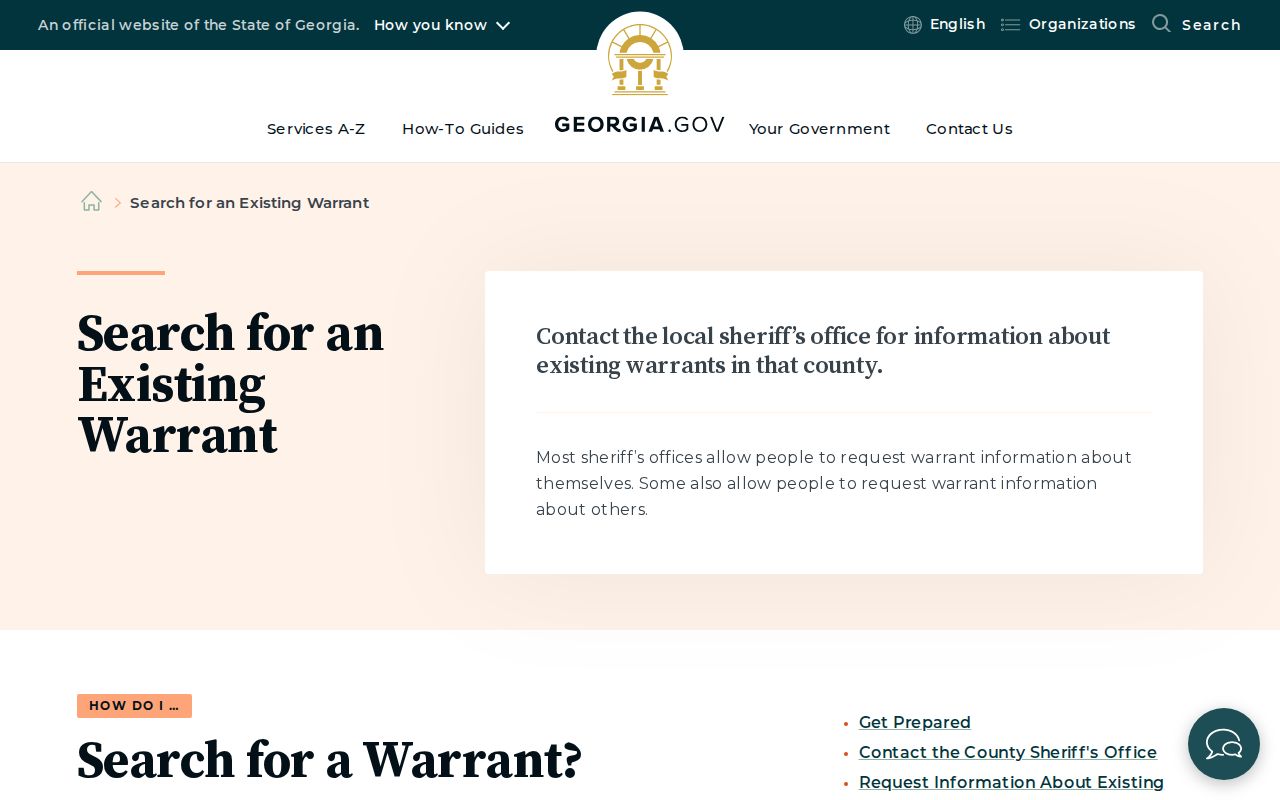
That guidance backs a direct agency check. It does not promise that a statewide search page holds every county warrant.
What a Whitfield Wanted Listing Shows
No active local list could be verified. A Whitfield-specific inventory therefore cannot honestly list a name count, photos, warrant basis, or update date. The table below records what county sources did and did not support. It keeps a generic wanted-list design from being mistaken for a real WCSO publication.
| Listing detail | Verified Whitfield status |
|---|---|
| Public list URL | No active WCSO P2C Wanted Persons or Most Wanted Persons module was verified. |
| Number of people | No supported public count. Absence of a list is not proof that no warrant exists. |
| Photo policy | No local public wanted-list photo policy was verified. |
| Warrant or charge text | WCSO Court Services maintains law-enforcement warrant data, but no public listing field set was published. |
| Tips, rewards, or anonymity | No county-specific public feature was verified. Use official emergency or nonemergency channels instead. |
| Update cadence | No public cadence was verified. Do not assign a daily, weekly, or social-media schedule. |
A photo on an unofficial page is no substitute for official confirmation. It can be old, misidentified, or tied to a prior booking. Compare full name, age, dates, agency, and case details first. Then ask the originating office.
How to Check a Whitfield Warrant
WCSO's dedicated warrant line is 706-876-1462. Georgia's official Search for an Existing Warrant guidance sends people to the county sheriff. Sheriff offices generally provide the way to ask about an active warrant. A court search can show a case, though. A case file is not the same as law-enforcement confirmation that a warrant remains active.
- Write down the identifying information you have, including the person's full legal name and any case number. Do not rely on a face or common name alone.
- Call the WCSO warrant line at 706-876-1462 and ask what information the unit can confirm and what identification or procedure it requires.
- Use the Whitfield Magistrate party search for case context. Search by at least two letters of the last name, then narrow by first name, division, filing date, or status.
- If the matter may be in Superior Court, use Georgia Courts' E-Access route to the proper court service.
- If the possible warrant concerns you, speak with counsel or the issuing court about a lawful response. Do not try to avoid service or give instructions to someone else about evading law enforcement.
Ask which source is authoritative for your question. Court Services, the clerk, and the warrant unit each do different work, and a public case search may lag or leave out law-enforcement status.
Keep the question narrow when you call. Ask whether the unit can confirm an active warrant for the named person, which office issued it, and what lawful next step the unit or court requires. Do not expect a clerk to guarantee what only the warrant database can confirm, and do not assume a closed case answers every warrant-status question.
Whitfield Warrant Record Types
Local documentation supports a narrow description, not a long generic list. Magistrate Court is the warrant-issuing court. Court Services receives those warrants for entry and service. Other court records can add context without proving a warrant is still in force.
| Record or warrant context | What the source can establish |
|---|---|
| Magistrate-issued warrant | WCSO says Magistrate Court issues warrants and forwards them to Court Services for entry and service. |
| GCIC or NCIC wanted-person entry | Court Services maintains law-enforcement wanted-person information in these systems. This is not a public search result. |
| Magistrate court case | The public case search can provide filing and status context, but it is not a live warrant confirmation. |
| Superior Court case | Georgia Courts' E-Access route can lead to Superior Court records when that court has the case. The research does not support a broader public warrant field list. |
Do not lump every document together. A bench issue, criminal warrant, summons, court filing, and database entry are not the same thing. No source here draws that line for you. The warrant unit can explain local status far better than any generalized page.
Whitfield Court Services and Warrant Data
WCSO Court Services sits between the issuing court and the law-enforcement record. The division forwards magistrate warrants for entry. It maintains wanted-person information in GCIC and NCIC. It also serves criminal warrants. That is why a public P2C roster helps with custody questions but falls short as a full warrant database.
A warrant can name someone not in the Whitfield jail. A current inmate result may show a booking. It can still leave another warrant's status unknown. Use the warrant line for warrants, P2C for custody, and the court record for filings.
Whitfield Court Context After a Warrant
Warrants and court cases are two different questions in Whitfield County. The Magistrate Court issues warrants. Superior Court handles most major criminal trials. Probate Court takes most traffic matters. Juvenile Court covers juvenile cases. Knowing which division holds a case helps a caller get straight answers from the warrant unit.
One caution deserves repeating. The Magistrate Court's online warrant-application page is a filing path for people with a recent incident report. It is not a public warrant lookup. Confusing an application form with an active warrant can leave someone at the wrong office with false confidence.
The public court interface offers case context. It is not a wanted list or photo gallery. Pull the division, filing date, and status from a case search first. That detail makes a call to Court Services far more precise. WCSO remains the office that can confirm whether a warrant is actually active.
Warrant Tips and Safety Contacts
Whitfield County has no verified public wanted list and no county-specific tip program. So there is no reward amount or anonymous-tip promise to report. Immediate danger always means 911. For ordinary information, call WCSO's nonemergency dispatch line at 706-370-4900. The sheriff's main 24-hour number is 706-278-1233. Never confront, follow, threaten, or try to detain anyone yourself. Pass what you know to the people trained to act on it.
WCSO Warrant Contact
Warrant line: 706-876-1462
Immediate danger: 911
Nonemergency dispatch: 706-370-4900
Call for the agency's current process. Do not approach a person believed to be wanted.
Treat names and photos in any secondary story as leads to verify. They are never a call to action. A wanted listing, even an official one, is simply the product of a warrant process. The outcome belongs to the court.
If the Warrant May Be Yours
Think a Whitfield County warrant has your name on it? Do not probe the system through a public photo. Do not send a stranger to ask. A lawyer, the issuing court, or the warrant unit can explain the lawful way to resolve the matter. Counsel can also sort out what kind of problem it is: a missed court date, a new charge, mistaken identity, or some other record mix-up.
Surrender, a court appearance, bond, and release decisions are steps in the legal process. They settle nothing on their own. The case outcome arrives later through the court record.